BSPP and G Are the Same? Key Differences of Thread Pipe Gauges
If you've ever worked with pipe threads, you've probably seen both BSPP and G used interchangeably — on drawings, datasheets, and even on gauge labels. At first glance, it might seem confusing: are they actually the same standard, or is there a hidden difference that could cost you a failed fit or a leaking joint?
Let's clear this up once and for all.
BSPP and G Thread Gauges: The Short Answer
Yes — BSPP and G refer to the same type of thread.
BSPP stands for British Standard Pipe Parallel G is the designation used in ISO standards for the exact same thread form
So when someone specifies a G pipe thread, they are referring to a BSPP thread. No difference in geometry, no hidden catch — just two names for one standard.
This also means that a BSPP thread gauge and a G thread gauge are interchangeable. If your gauge is marked G 1/2, it will correctly check a BSPP 1/2 thread — and vice versa.
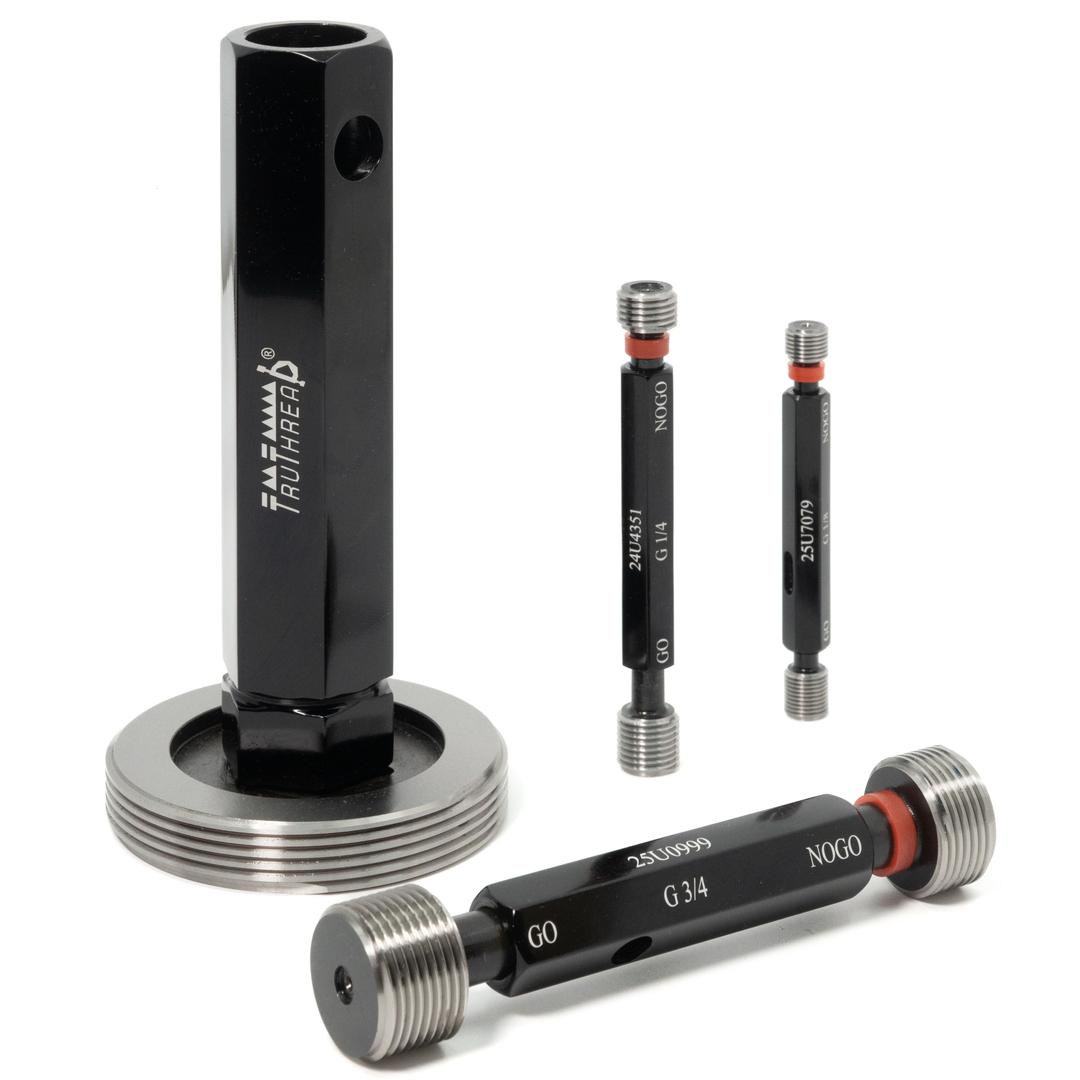
Why Do Two Names for Parallel Pipe Thread Gauges Exist?
The dual naming comes down to the evolution of engineering standards.
BSPP originates from British Standards (historically BS 2779) G is the designation adopted by ISO 228, the international standard that replaced and harmonized the British one
In ISO 228 documentation, pipe threads are marked as:
- G → parallel thread (= BSPP)
- R → tapered thread (= BSPT)
So the full picture looks like this:
Designation
Type
Standard
G
Parallel (straight)
ISO 228
BSPP
Parallel (straight)
BS 2779
R / BSPT
Tapered
ISO 7 / BS 21
Bottom line: G = BSPP. Same thread geometry, same gauging requirements — different labels depending on which standard your documentation follows.
Key Characteristics of BSPP / G Thread Gauges
Whether marked BSPP or G, the thread properties are identical:
- Parallel (straight) profile — no taper
- Whitworth thread form — 55° flank angle Sealing is NOT achieved on the thread itself
That last point is critical — and it directly affects how you should gauge and inspect these threads.
Unlike tapered threads (NPT, BSPT), BSPP/G threads rely on face sealing, using:
- O-rings
- Copper or bonded washers
- Flat-face fittings The thread itself provides mechanical engagement only. If you attempt to seal a G thread the way you would seal an NPT — by torquing the taper — you will get leaks. Every time.
This is why correct gauging matters: a G/BSPP thread gauge checks that the parallel profile, pitch, and diameter are all within tolerance so the sealing face can do its job properly.
Where G Pipe Thread Gauges Are Commonly Used
G (BSPP) threads — and the gauges used to inspect them — are standard across:
- Hydraulic systems and high-pressure fittings
- Pneumatic components and manifolds
- European and Asian industrial machinery
- Fluid transfer systems in manufacturing
If you're producing or inspecting components for any of these industries, you need gauges specifically calibrated to ISO 228 — not NPT, not metric, not "close enough."
How to use Gauge G / BSPP Threads Correctly
This is where errors creep in — and where the right tooling makes all the difference.
- A proper pipe thread gauge for G (BSPP) threads verifies:
- Correct pitch (threads per inch, per ISO 228)
- Accurate major and minor diameters
- Go / No-Go tolerance compliance
Using an incorrect gauge — for example, an NPT gauge on a G thread — will produce false readings. The thread may appear to pass inspection while still being out of tolerance for its actual application. That means bad fits in the field, leaks under pressure, and costly rework.
For quality control and manufacturing environments, using a calibrated G thread gauge is not optional — it is the only reliable way to confirm ISO 228 compliance.
Common Confusion to Avoid
Let's address the most frequent mistakes directly:
❌ "BSPP and G are different standards" — They are not. G is simply the ISO designation for BSPP.
❌ "G pipe threads seal on the thread itself" — They do not. Sealing requires a washer or O-ring on the face.
❌ "BSPP gauges work for NPT threads" — Absolutely not. BSPP/G and NPT have different thread forms, different angles, and different tolerances. They require separate gauges.
Mixing up G (BSPP) and NPT is one of the most common — and most avoidable — mistakes in pipe fitting. The threads may appear similar, but they are geometrically incompatible and require completely different gauging tools.
Final Answer — Are BSPP and G the Same?
Yes. BSPP and G are two names for the same parallel pipe thread standard. BSPP comes from British Standards; G comes from ISO 228. The thread geometry, pitch, and gauging requirements are identical.
If your components are specified to either standard, a G / BSPP thread gauge — properly calibrated to ISO 228 — is the correct tool for inspection.